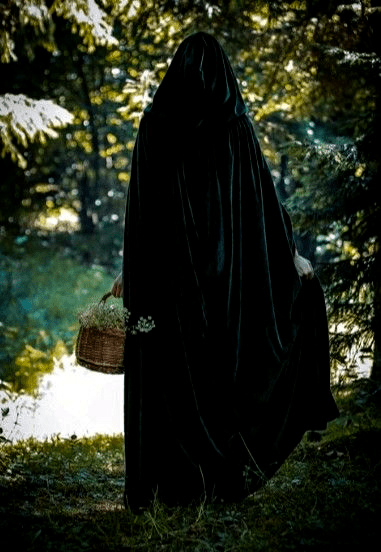
When thinking of witches, one’s thought may recollect pop culture successes such as Harry Potter, His Dark Materials, The Wizard of Oz, Hocus Pocus, or even fairy tales like Snow White and Sleeping Beauty. But is a witch an ugly old lady with vengeful, wicked intentions? Is it always someone with ostentatious powers and visible psychic abilities? I wouldn’t say so.
Perhaps to get our minds acquainted with the renegade, the exaggerated stereotypes became more popular and even, to some extent, glorified. I doubt, though, that the truthful archetype of witch would be so openly represented, as there is always a certain itch from people – especially because the witch is the embodiment of traits of consciousness exiled in society, which have always existed but are returning more and more, in a quiet way.
A witch, speaking of the unadultered archetype, is one of many names given to the woman who acts as a channel for the mysteries of nature and of creation within, bridging the unseen with the material world. She utilises the quintessence of the feminine polarity (intuition and emotion) to bring about her service in the world and to simply be her own self. Above all, a witch is a woman dedicated to the responsibility of healing her own self and of restoring her whole self, spirit + body + mind + emotions & senses, at the same time she helps to bring healing and wisdom to others. She serves others and self through aligning with the forces of nature and of the cosmos (within and without) and through reminding others of the subtle. In this world, a witch is a braveheart.
One does not choose to be a witch; one remembers it.
There are certainly other names associated to witch; sorceress, magician, healer, psychic, mystic, intuitive, wolf-woman, shaman and, even, priestess. As explained previously, a priestess, just like a witch, partners up with the unseen and acts as a channel and force of healing and inspiration, utilising the wisdom of nature, of the stars, and of Spirit itself. Through her principles and voice, devotions and rituals (which may be as ordinary as dancing or as detailed as chanting a mantra in a circle or making an altar/visionboard), she brings together the invisible and the visible, the old and the new.
Of course there is the old characteristic – witches have always been associated to persecution. This exclusion and living on the margins of society is indeed a life theme of the person who identifies with this archetype in their soul. Through the good times I would say this is the very thing that adds the “charm” and the mystique of the sorceress (connected with Source); the thriving and the beauty in an otherwise dark, saddening place, having changed it. Thus, it can also be said that a witch is an alchemist. It is to be able to extract power, gold (which is wisdom and healing), from something once chaotic, difficult to understand or that apparently (and only apparently) lacks life. And it is the act of imbuing this world with their love and care, through a genuine preoccupation for service and for good change, using the transformative essence of their own healing and faculties; that is the highest power and what makes a powerful witch.
Good ol’ questions: Do I have to do specific things in order to be a witch? Make specific rituals, wear crystals, punctually celebrate the wheel of the year, and offer my womb blood to the earth on a moonlit forest? No (although the latter would be pretty cool and I haven’t had the opportunity yet). Being always come first. A witch simply is a witch. It’s the consciousness. And I would say, it’s a spoonful of intuition.
A curious heart and a thirst for more in life, for truth, for tackling uncomfortable and challenging questions. To be loud in a quiet place, and at times to work and have the bravery to be loud; to let our voice be heard after centuries of silence and hiding. That is to be a good witch.
Extras
Here is the meaning of a few elements popularly associated to witches.
Spells – Through words, it is to crystallize and voice an intention in this world so that something can manifest.
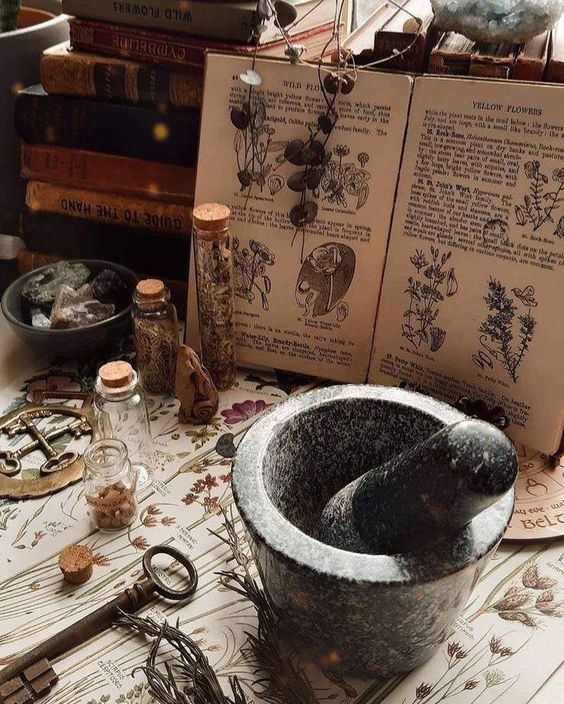
Potions – Tinctures made with plants and minerals to create remedies or perfumes (present in apothecaries). Formulated by herbalists or persons with that knowledge.
Divination tools – Crystal/scrying ball, tarot, runes, osteomancy and others are tools that can be used as forms of psychic practise, to access information that is yet unknown.
Black cat – Felines have long been associated with psychic connection and civilizations like Ancient Egypt and the Maya knew this. Thus, they are a symbol of the feminine polarity and dynamic, as well as the colour black, which is the void that contains all answers occulted (very much like the night sky or the cosmos in itself :).
The Moon – The celestial body that is commonly associated to the feminine polarity and that gravitationally influences ocean tides, as well as a woman’s menstrual cycle through her phases. Connected to water (emotions and the subconscious), as well as to the dark (intuition, shadow/occult potential and stored wounds).
Interesting take on the etymology
The etymology I find acceptable connects wicca with the verb wit “know” (as in to wit, the noun wit, witty, unwitting, and witless). Yet this derivation, arguably the best we have, is not flawless either. It presupposes the existence of witga (pronounced witya), the form that later developed into witch. The difficulty is that the combination tg (= ty) yielded (t)ch in extremely few words. However, the verb fetch was probably one of them. Old English had wita “wise man” and witega “wise man, prophet, soothsayer.” Witga, a third member of this family, would have meant approximately the same as witega, but with the accent on occult practices and knowledge of things hidden. If so, the negative meaning of witch developed later, under the influence of Christian teachings. Both wita and witega died out early, whereas witch has continued into the present. This reconstruction of the prehistory of witch has the support of Slavic: the Russian for witch is ved’ma “she who knows” (a similar form exists in several other Slavic languages), with ved– “know” being an easily recognizable cognate of wit. – Anatoly Liberman
 𓆖 JADE NIKITA
Leave a comment